
Change the Narrative?
Getting beyond an overused phrase and getting to plot and character in advocacy

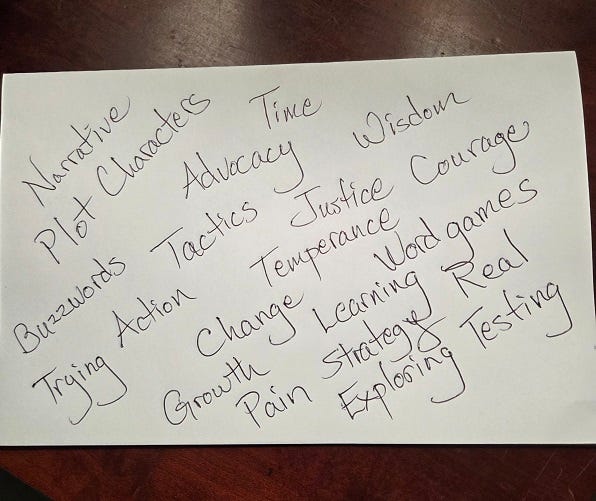
Every field has its buzzwords and phrases. “Change the narrative” is everywhere from popular articles to panels about advocacy, life, and everything in between.
When certain words and phrases are suddenly everywhere outside their usual field (literature, in this case), you can bet that their meaning is unclear. They may also be blocking what we would like to say and what we need to say.
Specifically: Here’s an example. I was on the phone with someone newer to advocacy recently and listening as she described her struggles. She got to a point in the conversation where she was trying hard but still feeling frustrated. She said, “I don’t know; we just need to [after a pause] change the narrative.” My guess is that she was reaching for words to express what she wanted to accomplish in advocacy. She got stuck and used a popular phrase that she may have read or heard over and over.
What’s in a narrative? My advice to her was that if she wanted to change the narrative, she could begin by changing what her group was doing. The significant components of a narrative are, after all, the plot or the action and the characters.
Not magic spells: Where people perhaps get stuck with the phrase “change the narrative” is that they think it means something like branding or messaging. If we tinker with some words, then we have changed the narrative, so the notion goes. But that sounds more like pronouncing a magic spell and hoping you’ll get change. There are no magic words that will help you change the narrative every time and in every situation. You have to work on the plot/action and the characters.
Changing the plot: You can change the plot by changing the action. The short answer is that you can look at your tactics and explore what you might be missing. If you only protest, are you missing out on putting together phone banks and email campaigns? If you only do “behind the scenes” lobbying, you might be missing the benefits of media engagement, for example.
Changing the characters: One way to change the characters in the narrative is to change the people with whom you surround yourself. That means adding and subtracting. You need to meet new people and you might need to evaluate your relationship with some old acquaintances. You deserve to be with people who can supportively and strategically pursue justice with you. Chances are that some of them are already in your circle.
Growing your character: The character in the narrative you can most change is yourself. I think you do that by equipping yourself to do things better. That involves a strong element of learning, which comes from observing how others pursue advocacy, reading about the subject matter such as health care, environment, voting rights, etc., and trying it yourself to see what works.
Another aspect of growing your character is inward. That’s a big question that a paragraph is not big enough to tackle. But I would draw on the four old cardinal virtues. You grow your character in the narrative when you increase your capacity to be just, courageous, wise, and self-controlled in the face of the kinds of adversity we are facing. Advocacy will give you many opportunities to test those qualities of your character. Pain comes with that process, but you can build your powers for good despite the tough times.
Final advice: I’ll end with a list.
Try not to use or overuse buzzwords and phrases like “change the narrative” because they can obscure your meaning.
If you must use “change the narrative,” invite people to consider the parts of a narrative–plot/action and character–and how they can work on both constructively to improve their advocacy.
Don’t try to accomplish everything at once. You can’t change the characters around you and your own character or shift all your action in one week. Make steady progress where you can on each part and you will be on the way to changing the narrative.